Choose a Stock API by Testing Requirements Before Comparing Price
TickDB Research ·
A stock API can return valid JSON and still be unsuitable for your application. Choose candidates that meet your required data coverage, permitted use and operating capacity, then compare their total cost under the same workload. Alpaca’s documented IEX and SIP feed distinction shows why matching ticker symbols is not enough. A small acceptance test, with unresolved requirements kept visible, produces a more defensible shortlist than a feature count.

For an internal end-of-day research tool, prioritize the historical universe, corporate-action treatment and reproducibility. For a customer-facing price display, prioritize permission for that use, the required quote coverage and session behavior, then test delivery and recovery under load. These applications can reasonably select different providers even when their developers start with the same search: “stock API.”
The useful comparison unit is a particular feed and plan used for a particular job. A provider’s broad product page is only the beginning of that comparison. This article develops an acceptance method, not a measured ranking of providers.
Turn the application into a data contract
Start with one sentence precise enough to fail a candidate. For example: “Display last-trade prices for a defined list of US stocks during regular trading hours, with an explicit stale state, for external customers.” This is an illustrative requirement, not a statement about any provider’s license.
The words in that sentence have consequences. A last trade is different from a best bid or ask. Regular hours exclude other sessions unless you add them. External customers create a different permission question from a private prototype. An explicit stale state means the application must preserve data time and detect failures even when its own server continues answering requests.
Write down the following evidence before requesting a quote. Keep the requirements specific to the application; unnecessary requirements can eliminate a suitable, simpler service.
| Requirement | Evidence to obtain | Acceptance decision |
|---|---|---|
| Instruments and price meaning | Symbol list, venues or feed scope, trade versus quote, session definitions | Required instruments and semantics match |
| Intended use | Written terms or confirmation covering audience, display, storage and redistribution where relevant | The actual use is covered |
| History | Date range, delisted instruments where needed, adjustment and correction policy | Research can be reproduced within the required scope |
| Operating capacity | Plan limits and a trial using expected subscriptions, bursts and recovery traffic | Workload fits with agreed headroom |
| Failure behavior | Timeout, rejection, stale-data and reconnect observations | Failures are visible and recovery is acceptable |
Treat a missing answer as unresolved. It is not proof that a provider lacks a capability, but it is also not a passing result. Keep permission questions with the applicable agreement and obtain confirmation from the provider; an API response alone cannot establish permitted use.
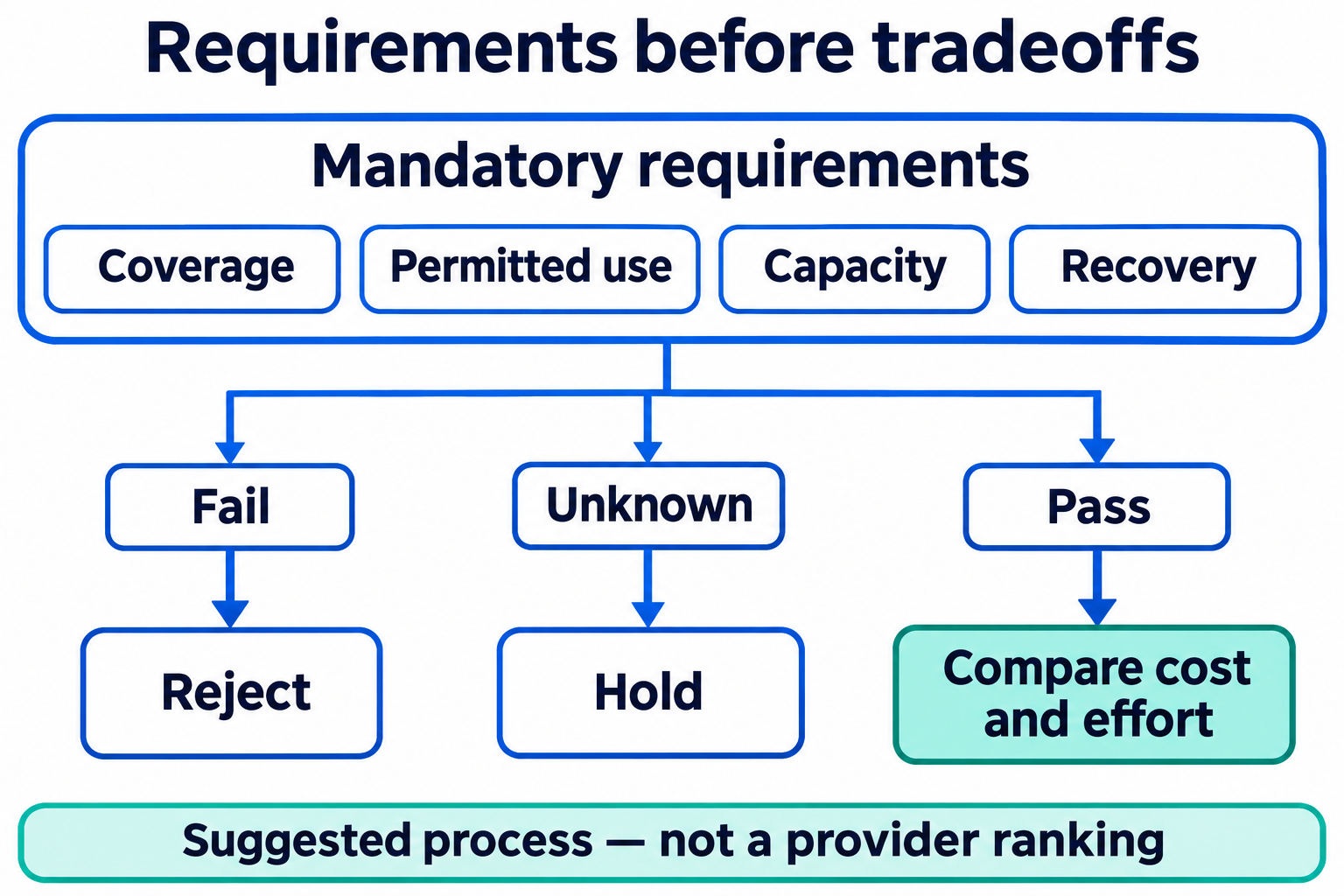
Figure 1. Clear mandatory requirements before comparing cost and integration effort. This is a suggested evaluation process, not a provider ranking.
Compare the feed before comparing the price
Alpaca’s Market Data FAQ distinguishes an IEX feed from a SIP feed and exposes a feed choice for historical queries. That distinction matters even when both requests use the same stock symbol: a feed limited to one venue and a consolidated feed do not describe the same set of market events. A price or volume difference between them is not, by itself, evidence of an error. These statements describe the documentation reviewed on November 9, 2026, not a new market-data test.
Specify the required feed explicitly in a trial and record the account entitlement used. Otherwise, a comparison can quietly change when a subscription changes or a default selects a different feed. Compare identical sessions, event types, bar boundaries and adjustment settings wherever those controls exist. If they cannot be aligned, document the difference instead of reporting an accuracy score.
TickDB is a relevant candidate for applications evaluating US, Hong Kong and mainland China stock data: its Ticker Snapshot documentation lists examples from those markets. The same page describes a maximum of 50 symbols per snapshot request and conditional availability for fields beyond symbol, last price and timestamp. Those are useful inputs to a trial. They do not establish the feed’s suitability for every display requirement, nor do they confirm redistribution rights or measured reliability.
For a trade-price display, check the required last-price fields first. If your application also needs bid and ask, make their availability for your instruments a separate acceptance condition. A sample response containing a field is weaker evidence than a defined field contract plus a trial across the sessions you actually use.
Make unknown requirements visible in code
A weighted score can hide a fatal problem. A candidate with attractive cost and excellent documentation still cannot pass a mandatory requirement whose status is unknown. The following Python example implements that distinction before any ranking takes place.
The input is an assessment record created by your team after reviewing evidence. The names and values below are fictional; the function does not inspect contracts, query providers or measure data quality. It requires an explicit True, False or None for each mandatory criterion. Missing entries remain unresolved.
REQUIRED = ("coverage", "permitted_use", "capacity", "recovery")


def assess(checks):
    failed, unknown = [], []
    for name in REQUIRED:
        value = checks.get(name)
        if value is not True and value is not False and value is not None:
            raise ValueError(f"{name}: use True, False or None")
        if value is False:
            failed.append(name)
        elif value is None:
            unknown.append(name)
    status = "reject" if failed else "hold" if unknown else "eligible"
    return {"status": status, "failed": failed, "unknown": unknown}


candidates = {
    "Candidate A": dict.fromkeys(REQUIRED, True),
    "Candidate B": {**dict.fromkeys(REQUIRED, True),
                    "permitted_use": None},
    "Candidate C": {**dict.fromkeys(REQUIRED, True),
                    "capacity": False},
}
for name, checks in candidates.items():
    print(name, assess(checks))
A becomes eligible for comparison; B stays on hold until the permission question is resolved; C fails the current capacity requirement. A failed requirement takes precedence over an unknown one, while the returned record retains both lists. “Reject” means unsuitable under the assessed requirements and plan, not unsuitable for every customer.
Attach an evidence reference, reviewer and review date to each real assessment in your own record system. The compact code deliberately omits that storage layer. Rerun the decision when requirements or plans change; a saved Boolean should not outlive the evidence that justified it.
Run a trial that can reveal a bad fit
Use the same instrument set, time window, receiving environment and requested data meaning for each candidate. Include actively traded instruments, less active instruments and any relevant session transitions. A quiet stock’s old last-trade timestamp may simply mean that no new trade occurred. Measure transport health separately from event age so that you do not label all inactivity as an outage.
Record request start and completion times, HTTP status, requested and returned symbols, source timestamps and parse failures. For streams, also record subscription acknowledgements, disconnects and the first valid update after recovery. Preserve enough raw samples to investigate a discrepancy without retaining credentials. Use a monotonic clock for elapsed durations and a synchronized wall clock when comparing data timestamps with receive time.
Calculate request success as successful requests divided by attempted requests, and report missing requested symbols separately. A successful HTTP response can still omit an instrument. Define a freshness threshold from the application’s needs before the trial, report the eligible observation count, and separate regular hours from closed sessions. Receive time minus source time includes more than network delay and depends on timestamp semantics; do not label it end-to-end feed latency without that qualification.
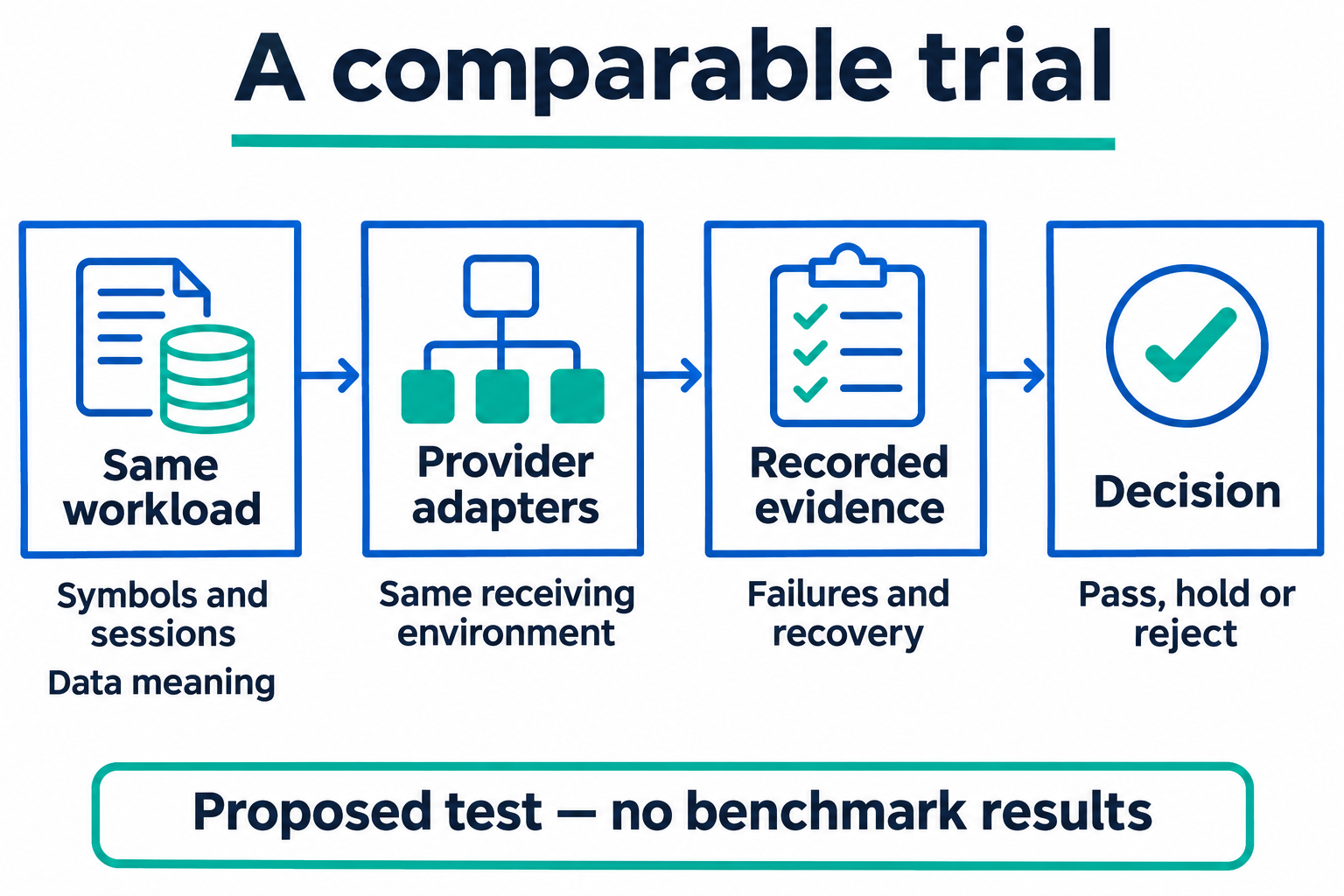
Figure 2. Apply the same workload and preserve evidence before accepting a candidate. The diagram represents a proposed test, not measured results.
Test a controlled interruption as well as normal delivery. After reconnection, determine whether the service returns only a current snapshot, resumes updates or offers a documented way to recover the missing interval. A live display may tolerate an explicit stale state followed by a new snapshot. A system that must retain every event needs a stronger recovery contract. A short successful trial cannot prove a long-term availability commitment; assess the agreement and longer observation window separately.
Compare total cost among eligible candidates
Once the mandatory requirements pass, compare costs over the same period, currency and workload. Include the subscription, applicable data permissions or fees, extra usage, storage, network egress, implementation and ongoing operation. Record each item as quoted, included, estimated or unresolved. No provider prices or permission grants are assumed here.
Keep one-time migration effort separate from recurring spend, then evaluate both over a stated planning horizon. For example, an inexpensive subscription can require extra work if the application must compensate for a missing historical workflow. Conversely, a richer feed can be unnecessary expense when the application only requires a permitted delayed display. Neither conclusion follows from the headline price alone.
TickDB should pass the same assessment as every other candidate: confirm the intended usage and plan capacity, test the required instruments and fields, and record the unresolved items before comparing cost. Documentation can justify a shortlist; it cannot substitute for a workload trial or a permission decision.
The final selection record should say which requirement each candidate passed, what remains unknown, the cost assumptions and the conditions that would trigger reevaluation. If only one candidate passes, you have a conditional choice. If none pass, revise the plan, narrow the application requirement where acceptable, or keep searching. Lowering a score threshold does not resolve a failed requirement.
Source basis: Alpaca Market Data FAQ and TickDB Ticker Snapshot documentation, reviewed November 9, 2026. Product statements above are documentation-based. The assessment example uses fictional inputs; no live provider benchmark or contract review was performed for this article.
Disclosure: Prepared as technical content for the TickDB promotion workflow. This is not an independent provider benchmark.