Financial data in a backtest: When can you use earnings reported after the close?
TickDB Research ·
Financial data in a backtest: When can you use earnings reported after the close?
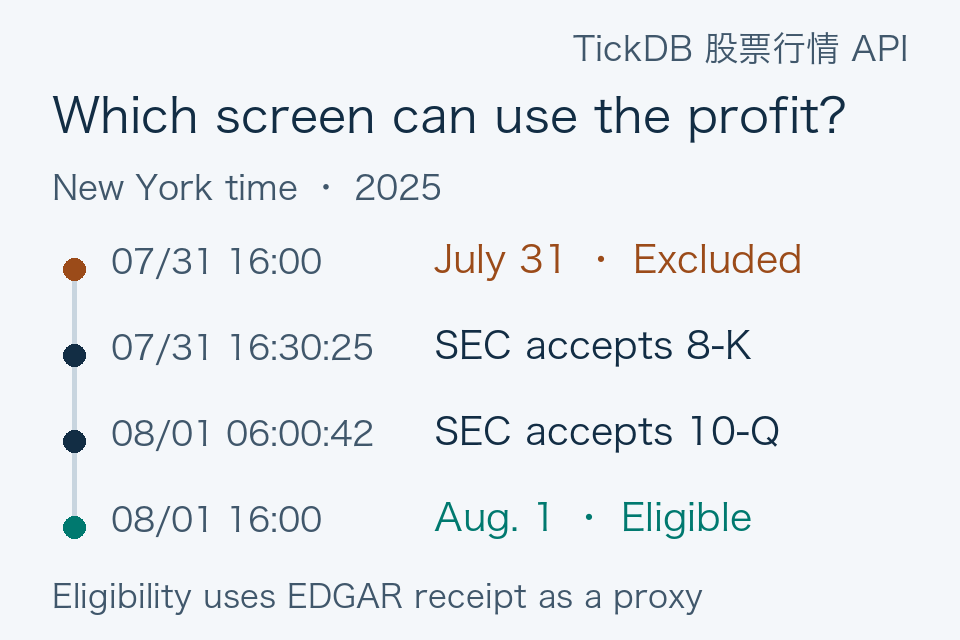
If your stock screen runs at 4 p.m. New York time, when can it use Apple's latest quarterly net income? Using EDGAR acceptance as a proxy, the July 31 screen cannot use the figure, while the August 1 screen can. We verify the amount against TickDB's response and the SEC exhibit, then show a cutoff check you can run on your own records.
Suppose your screen runs at 4 p.m. every trading day. Apple's fiscal Q3 2025 net income belongs to the quarter ended June 28. Joining it to daily bars on June 28 would let your backtest read the figure too early. On July 31, the screen would have run at 4 p.m. EDGAR accepted the 8-K containing the income statement at 4:30:25 p.m. We use that timestamp for the example. For your own backtest, check when the record became usable in your research system.
Verify the amount, then check when it was available
TickDB returned NetProfit of $23,434,000,000 with a period end of June 28, 2025. The net income row in Apple's 8-K exhibit shows 23,434, in millions of US dollars. That verifies the value and accounting period. To place it in a strategy run, we also need a dated disclosure record.
EDGAR records accepting the 8-K at 4:30:25 p.m. on July 31. It accepted the 10-Q at 6:00:42 a.m. on August 1. The earlier filing already contains the figure needed for this screen. All times are New York time.
Apply your strategy's cutoff
Keep these times separate. The period end identifies the quarter. The EDGAR acceptance record tells you when the filing reached the regulator. The first public release needs its own timestamp. Your ingestion log can tell you when that version became usable in your system. The API response we checked lacked that historical timestamp, so the example uses EDGAR acceptance as a proxy.
| Daily cutoff (New York) | Use the updated profit? | Reason |
|---|---|---|
| July 31, 2025 at 4 p.m. | No | The 8-K acceptance was later |
| August 1, 2025 at 4 p.m. | Yes, under this proxy | The 8-K acceptance was earlier |
This check tells you whether the screen may read the new figure. Whether it changes which stocks pass depends on the screening rules and other inputs.
Keep the dates you need to rerun the screen
Keep the symbol, period end, disclosure source, availability timestamp, version and strategy cutoff. TickDB supplies the amount, currency and period in the financial record. Your system log supplies the availability time. Select the newest version that was available by the cutoff. Store a later correction with its own availability timestamp.
from datetime import date, datetime, time
from zoneinfo import ZoneInfo

NY = ZoneInfo("America/New_York")

def can_use(received, session_day):
    if received.utcoffset() is None:
        raise ValueError("Arrival time must include a time zone")
    cutoff = datetime.combine(session_day, time(16), tzinfo=NY)
    return received.astimezone(NY) <= cutoff

proxy = datetime.fromisoformat("2025-07-31T16:30:25-04:00")
for day in ["2025-07-31", "2025-08-01"]:
    print(day, can_use(proxy, date.fromisoformat(day)))
This prints 2025-07-31 False and 2025-08-01 True. Replace proxy with your own time-zone-aware availability timestamp. The example builds a 4 p.m. New York cutoff for the date supplied, including when the clocks change. If your research needs historical prices, use daily bars for trading dates and prices, then match them to the financial records by instrument and availability time. TickDB US stocks and company financials
FAQ
What if I have only the period end? Mark availability as unknown. With a reliable disclosure record, you can document a proxy and test how the choice affects your results. To reconstruct what your system actually knew, look for the original ingestion records.
References
- SEC EDGAR, Apple Inc. Form 8-K and Exhibit 99.1, July 31, 2025, and Form 10-Q, August 1, 2025.
- SEC EDGAR FAQ, acceptance timestamps and filing dates.
- TickDB financial data response for AAPL.US, fiscal Q3 2025, income statement field
NetProfit.
Find the filings in EDGAR under accession numbers 0000320193-25-000071 (8-K and exhibit) and 0000320193-25-000073 (10-Q).
This week's offer

TickDB Black Friday Subscription Week runs November 23–29, 2026, ending at 11:59 p.m. Beijing time. Save 15% on semiannual billing and get half a month extra, or save 20% on annual billing and get one month extra. The offer applies to new paid subscriptions and renewals. The extra time is added automatically after payment.
7 markets · 42,688 symbols
- US stocks
- 14,386
- Hong Kong market
- 3,354
- China stocks, ETFs & bonds
- 7,576
- Forex & metals
- 1,228
- Indices
- 13,960
- Futures
- 1,172
- Crypto
- 1,012