How to reconcile an ex-dividend price change before the dividend arrives
TickDB Research ·
How to reconcile an ex-dividend price change before the dividend arrives
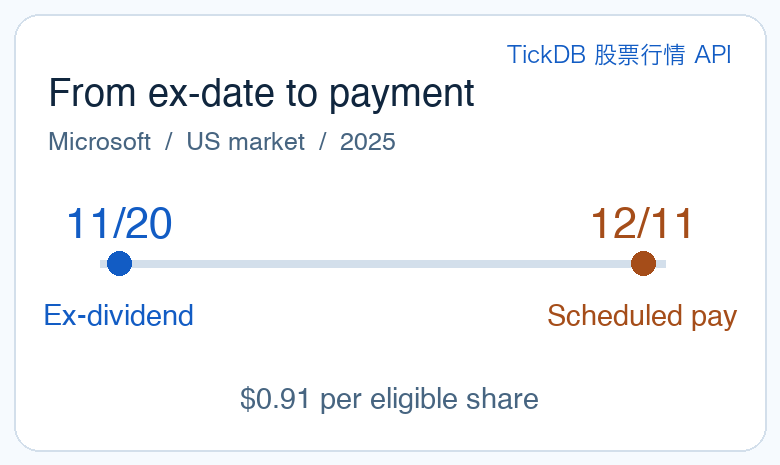
Microsoft closed $8.69 lower per share on November 20, 2025, its ex-dividend date. For an eligible holder, adding the $0.91 gross dividend entitlement gives a price-plus-dividend change of −$7.78. Here is how to reconcile the price, entitlement and eventual cash receipt.
Microsoft's unadjusted close moved from $487.12 on November 19 to $478.43 on November 20, 2025. The company announced a $0.91 cash dividend, payable December 11. An eligible holding could show a price loss on the earlier date while the scheduled payment lay weeks ahead.
Keep three entries in the ledger
| What to reconcile | Microsoft sample | Where to check |
|---|---|---|
| Price movement | $487.12 on Nov 19 → $478.43 on Nov 20 | Two unadjusted daily closes |
| Dividend entitlement | Nov 20 ex-dividend, $0.91 per eligible share | Issuer release and dividend event |
| Cash receipt | Scheduled for Dec 11 | Issuer's schedule and broker's actual ledger |
Microsoft's dated September 15 release lists November 20 as the ex-dividend and record date. The TickDB event agrees on those dates, the payment date and the amount. Its declaration-date field shows September 16. Use the issuer's release for the announcement date and retain both values when reconciling the sources. [1–2]
Calculate the change for one eligible share
Assume one eligible share held throughout, with no trades, and record the dividend before tax and fees. Subtract $487.12 from $478.43 for a price change of −$8.69. Add $0.91 for a price-plus-dividend change of −$7.78. A new purchase on the ex-dividend date would exclude this payment from its own ledger. This calculation separates the amounts for reconciliation. Trading also moves prices, so the observed loss is not a measure of the dividend's effect.
Use TickDB's unadjusted daily bars and the dividend event for the same symbol. Keep the ex-dividend date, scheduled payment, currency and amount next to the prices. If you start with a return series that already adjusts for dividends, check its method before adding another cash entry. [2] TickDB US Stock API
Apply the calculation to your own holding
Enter the unadjusted closes, dividend per share and number of eligible shares. Reconcile the eventual cash receipt against the broker's ledger after tax and fees. The example below is per share.
from decimal import Decimal as D
prior, current, dividend = map(D, ("487.12", "478.43", "0.91"))
for eligible in (True, False):
    price_change = current - prior
    entitlement = dividend if eligible else D(0)
    print(f"{eligible}: {price_change:.2f}, {price_change + entitlement:.2f}")
True: -8.69, -7.78
False: -8.69, -8.69
Frequently asked questions
What if the scheduled date has passed and cash is missing? Check eligibility, the broker's corporate action entry and settlement currency. Then reconcile withholding, fees and posting date.
What if the sources disagree on dates? Keep the issuer's release and the provider's field values. Check for an updated announcement before choosing the window.
References
- Microsoft Source, Microsoft announces quarterly dividend increase, September 15, 2025.
- TickDB Docs, dividend history and K-line queries. Sample: MSFT.US dividend event and unadjusted closes, November 19–20, 2025.
This week’s offer

November 23–29, 2026, through 23:59 Beijing time. Save 15% on six months and get an extra half month, or save 20% on a year and get an extra month. Eligible for new paid subscriptions and renewals.
Category coverage
- US stocks
- 14,809