When a REST Snapshot Arrives After a WebSocket Stock Quote
TickDB Research ·
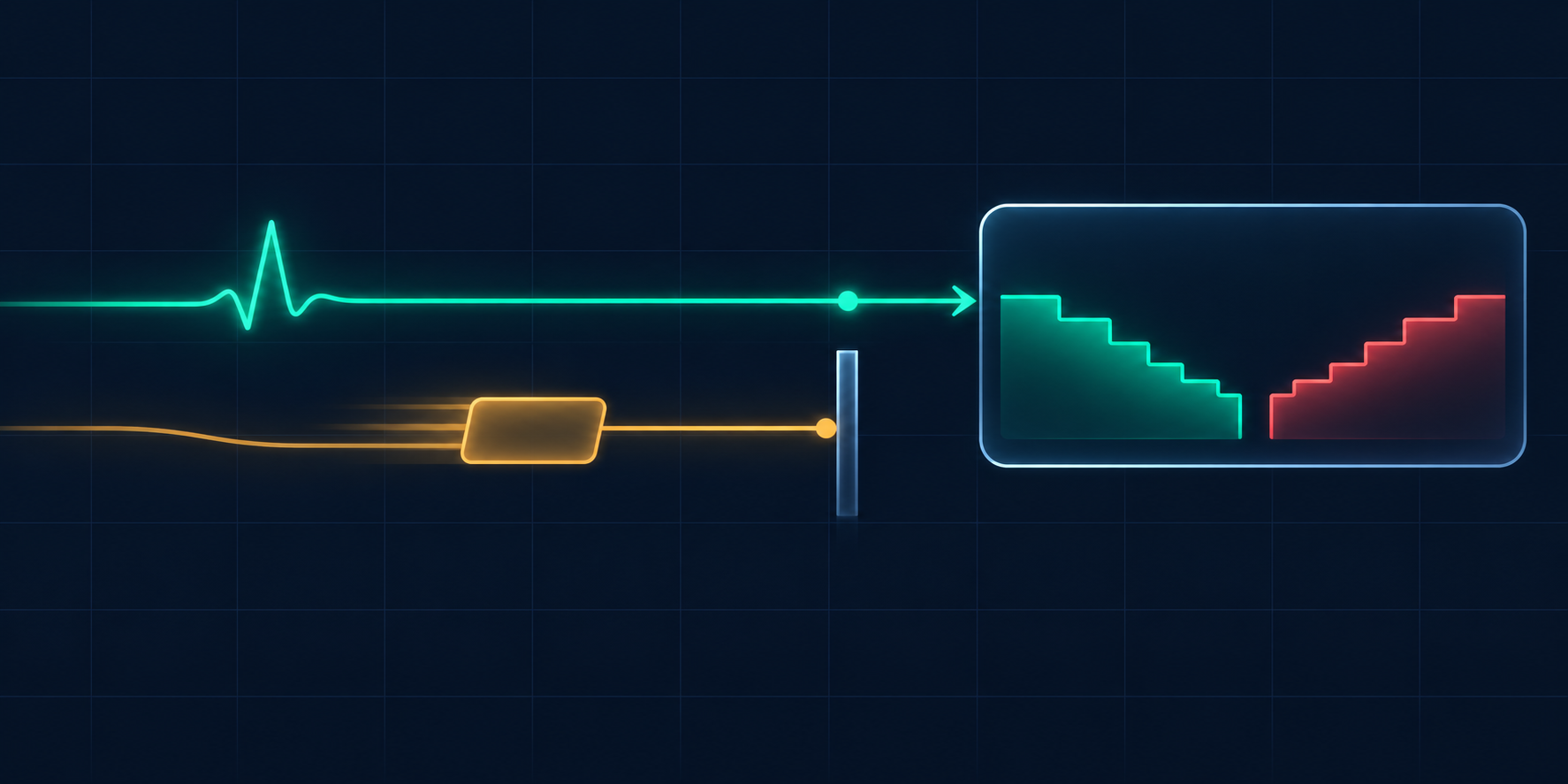
A Python quote card can move backward even when both data requests succeed. This happens when a WebSocket update reaches the app before an older REST snapshot finishes. Normalize both responses to the same kind of price, key the result by symbol and trading session, and replace the displayed value only when the incoming market-data timestamp is newer.
Use this rule for a display of the latest price, not for replaying every trade. An older message can still matter in a trade archive; it should not roll a quote card backward.
Why the newest response can contain the older price
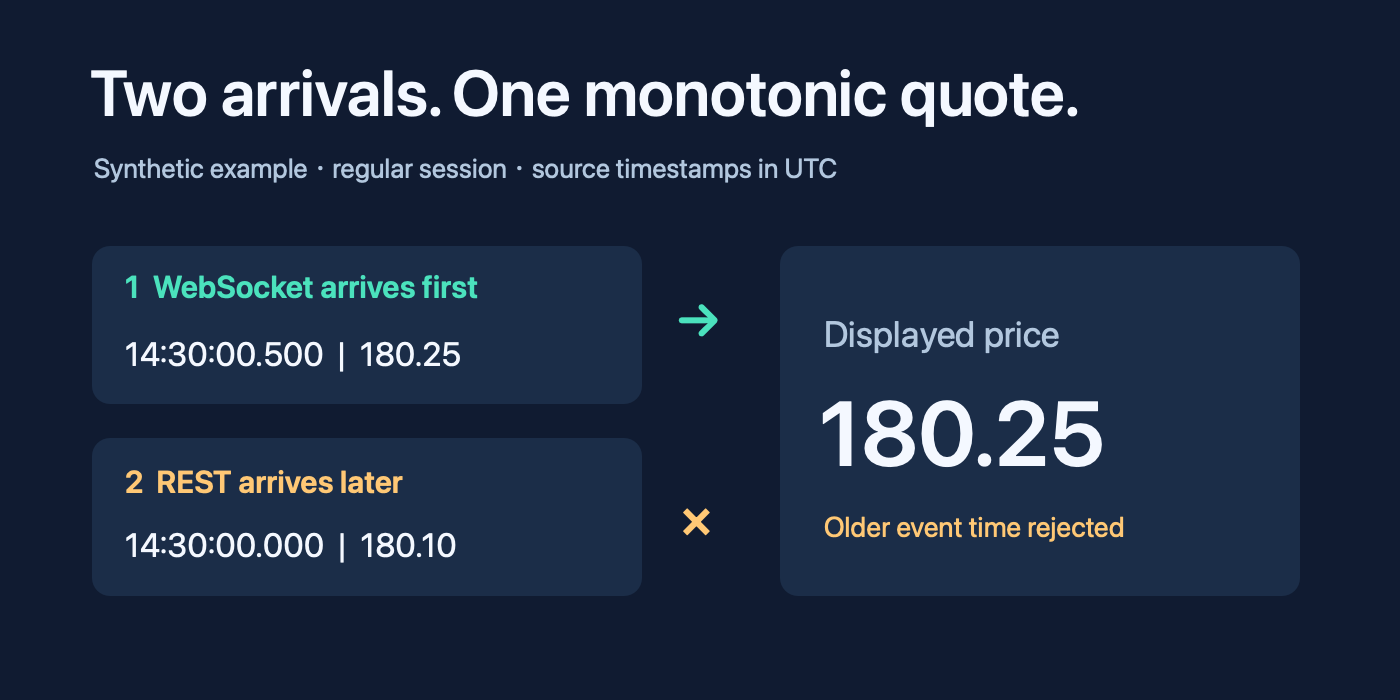
Suppose a WebSocket quote for AAPL arrives with data time 14:30:00.500 UTC and price 180.25. REST finishes later, but its data time is 14:30:00.000 and its price is 180.10. If both handlers simply assign to the same card, the card changes from 180.25 to 180.10 without a new market event. Comparing data timestamps keeps 180.25.
The prices and times below are synthetic, not observed AAPL trades or API latency measurements.
| Order in the app | Source | Market-data time, UTC | Last price | Decision |
|---|---|---|---|---|
| First | WebSocket | 14:30:00.500 | 180.25 | Show 180.25 |
| Second | REST | 14:30:00.000 | 180.10 | Keep 180.25 |
Record receive time separately. It's useful for diagnosing a slow request or a quiet stream, but it must not decide which price is newer.
Align the fields before comparing times
TickDB's REST Ticker Snapshot documents a last_price and a millisecond timestamp. Its extended-hours quote objects have their own last_done and timestamp. The WebSocket ticker schema carries last_price and timestamp; its U.S. stock examples use trade_session to identify pre_market, post_market, and overnight. Normalize documented regular and extended payloads to explicit session keys before comparing them. Don't let a newer extended-hours timestamp silently replace the regular-session price.
Compare last trade with last trade. If the card shows bid and ask too, define how those fields update instead of replacing everything with a partial message. Validate the application response, symbol and fields even after HTTP 200. Flag invalid timestamps and unrecognized session labels instead of substituting the app's receive time.
A minimal gate you can test without an account
The Python gate consumes already-normalized observations. It preserves the old price and reports a conflict when the same timestamp has two different prices. That's a display policy: equal timestamps do not prove that events are duplicates. For trade archives, rely on documented event identity, sequencing, or correction semantics instead.
from dataclasses import dataclass
from decimal import Decimal

@dataclass(frozen=True)
class Quote:
    symbol: str
    session: str
    event_ms: int
    price: Decimal
    source: str

class QuoteGate:
    def __init__(self):
        self.latest = {}

    def accept(self, q):
        key = (q.symbol, q.session)
        old = self.latest.get(key)
        if old is None or q.event_ms > old.event_ms:
            self.latest[key] = q
            return "accepted"
        if q.event_ms < old.event_ms:
            return "older"
        return "duplicate" if q.price == old.price else "conflict"

if __name__ == "__main__":
    t = 1795185000000  # Synthetic event-time base in milliseconds.
    gate = QuoteGate()
    cases = [
        ("regular", 500, "180.25", "websocket", "accepted"),
        ("regular", 0, "180.10", "rest", "older"),
        ("regular", 500, "180.25", "websocket", "duplicate"),
        ("regular", 500, "180.26", "websocket", "conflict"),
        ("pre_market", -1000, "179.90", "rest", "accepted"),
        ("regular", 800, "180.30", "rest", "accepted"),
    ]
    for session, offset, price, source, expected in cases:
        action = gate.accept(Quote("AAPL.US", session, t + offset, Decimal(price), source))
        assert action == expected, (source, offset, action)
        print(source, session, offset, price, action)
    assert gate.latest["AAPL.US", "regular"].price == Decimal("180.30")
    assert gate.latest["AAPL.US", "pre_market"].price == Decimal("179.90")
The local fixture checks six cases: first update, older REST response, repeat, equal-time conflict, separate pre-market price, and genuinely newer REST snapshot. All six assertions passed. Two additional assertions verify that the regular and pre-market values remain separate. No live feed, latency, or reconnect replay was tested.
In an async app, send both adapters' observations to one consumer queue, or put the comparison and write inside one lock. Otherwise both handlers can read the same old value and the slower handler can still win. A valid REST price can seed the display if the stream hasn't delivered one yet; the same gate handles either arrival order.
On reconnect, subscribe again as the provider requires. TickDB's current WebSocket guide documents resubscription and another initial snapshot for a full-market subscription. That snapshot can refresh the current view; it doesn't prove that all missed events were replayed. Track freshness separately from the connected state, using a threshold appropriate to the selected session and workload.
To accept this change, deliberately delay the older REST response and confirm neither the displayed price nor its data time rolls back. Also verify that equal-time conflicts are visible and extended-hours quotes can't overwrite the regular-session card.
Technical references checked: TickDB Ticker Snapshot, WebSocket Ticker, and WebSocket Best Practices. Written for TickDB Research. The merge policy also applies to other feeds exposing comparable timestamps and prices.
7 markets · 42,687 symbols
- US stocks
- 14,386
- Hong Kong market
- 3,353
- China stocks, ETFs & bonds
- 7,576
- Forex & metals
- 1,228
- Indices
- 13,960
- Futures
- 1,172
- Crypto
- 1,012