Choose a Stock API by Verifying Instrument Identity Before Comparing Prices
TickDB Research ·
A stock API can return a valid price for the wrong instrument if an integration treats a ticker as a universal identifier. Compare providers on their ability to resolve the requested instrument, retain exchange and currency context, and reject ambiguous mappings before scoring speed or cost. A small identity contract and deliberately conflicting test fixtures make these differences visible without pretending that a successful request proves historical coverage or entitlement.
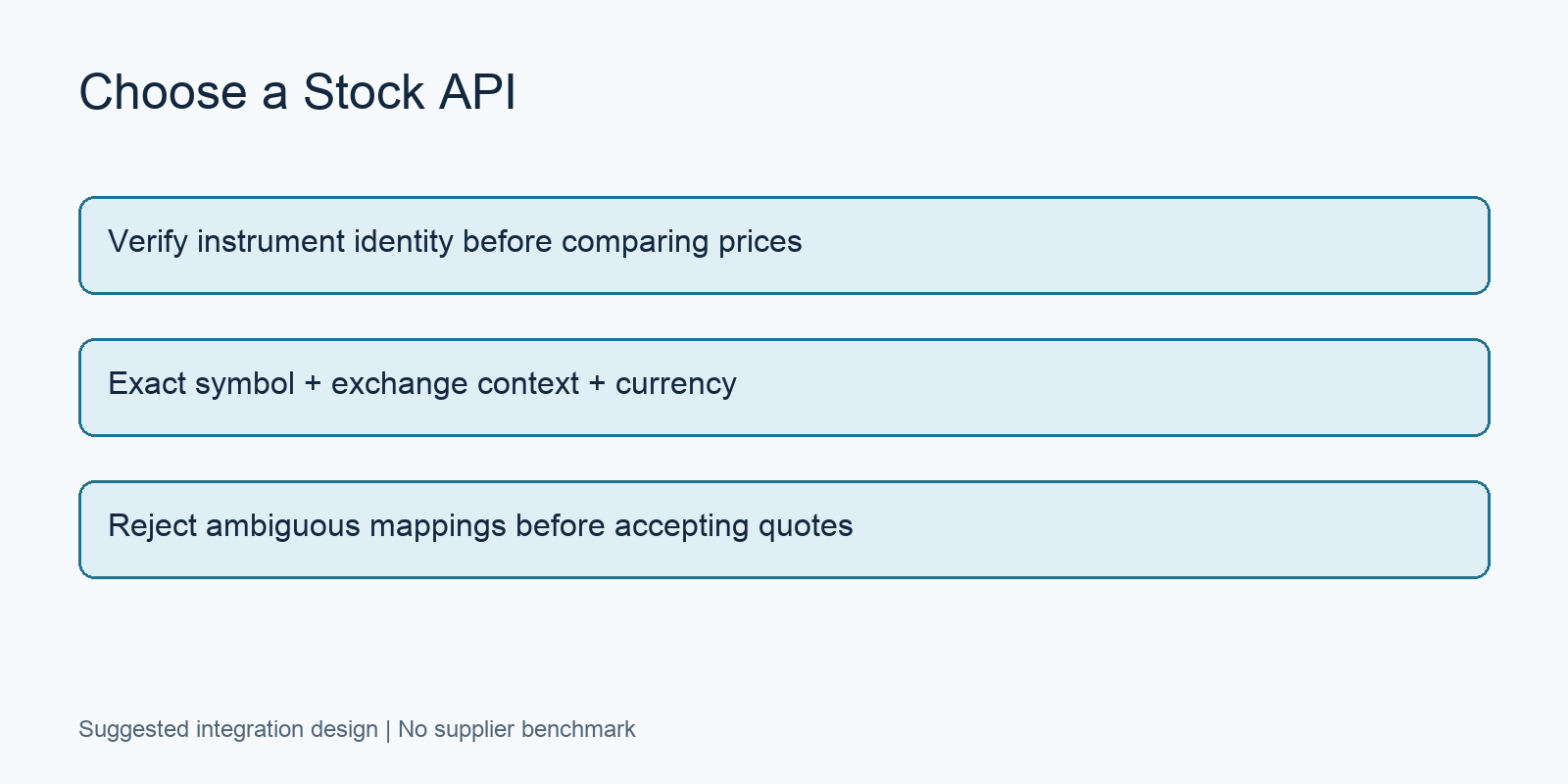
Resolve the instrument before trusting its price
For a multi-market watchlist, the first acceptance question is whether each response belongs to the security the user selected. A ticker string alone is not a complete identity contract. A market suffix can help distinguish a provider's symbol namespace, but it should not be silently treated as a globally stable instrument identifier.
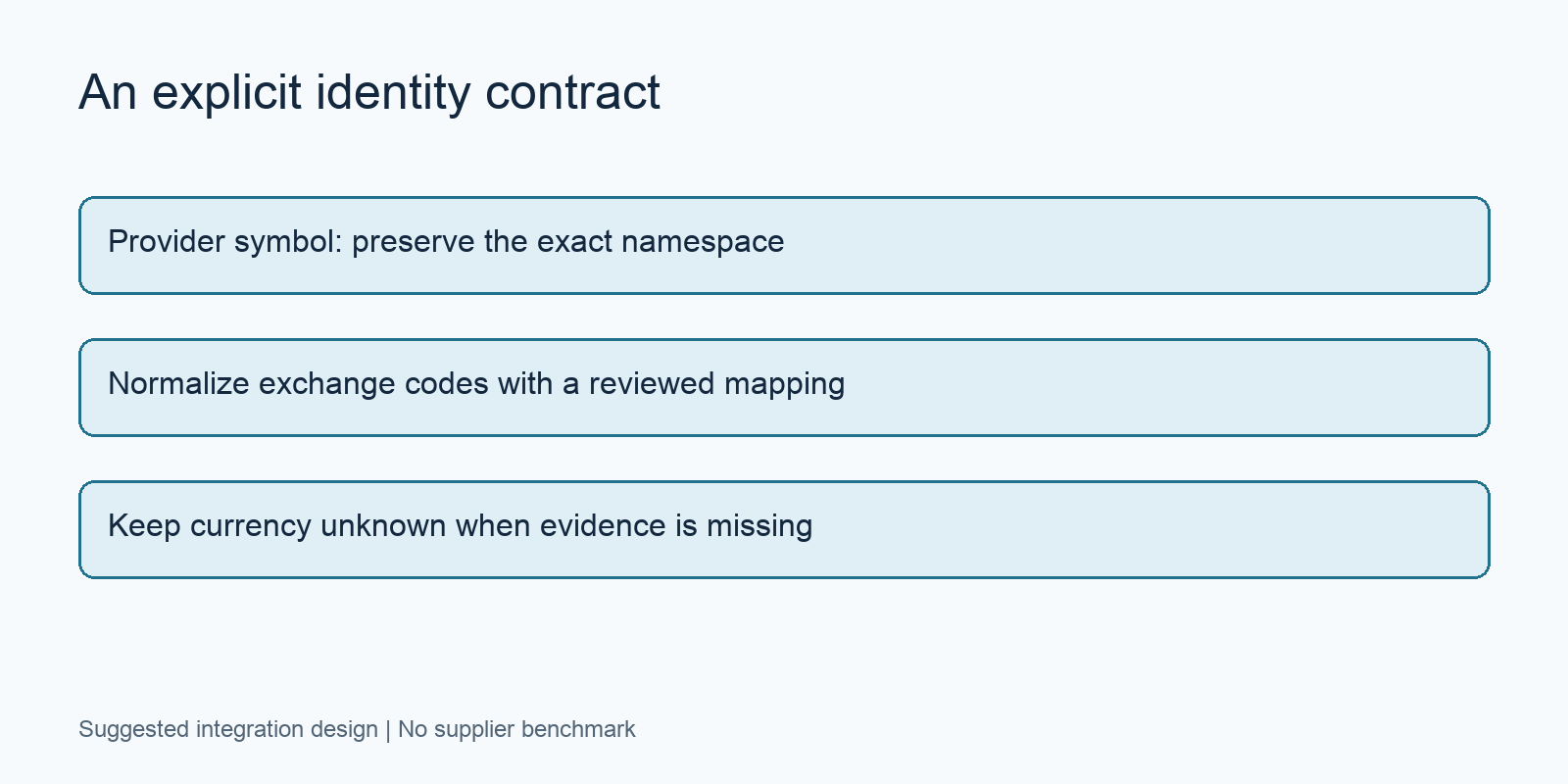
Store the provider's exact symbol alongside the expected market or exchange and currency. Keep a separate application identifier so that switching providers does not require rewriting every watchlist, alert and historical row. This is an integration design recommendation, not a claim that a particular provider guarantees permanent identifiers.
The difference matters when a mapping is incomplete. A request that returns HTTP success can still be unusable if the integration cannot establish which instrument it received. A blank currency must remain unknown; filling it with a convenient default turns missing evidence into a false assertion.
Make providers answer the same identity questions
Start with a small, documented basket representing the instruments your application actually supports. Include ordinary symbols, similarly named instruments across markets, malformed requests, and known historical changes if those changes matter to your product. Do not manufacture a claim that a real ticker changed merely to populate the test.
For every candidate, record its exact request symbol, returned symbol, exchange field, currency field, and behavior when the symbol is ambiguous or unsupported. Distinguish an explicit error from an empty result and from a successful response with missing metadata. All three require different handling in your adapter.
TickDB's stock-information documentation gives a concrete example of this contract. It lists symbols such as AAPL.US and 700.HK, describes exchange and currency fields, and documents an optional product type for disambiguation after an AMBIGUOUS_SYMBOL error. It also states that conditional fields may be omitted when data is unavailable. These are documentation statements checked on November 12, 2026, not results from a live account test.
Those details provide a starting point for an adapter. They do not establish that the endpoint supplies historical identifier mappings, delisted universes, or point-in-time metadata. If a backtest depends on those features, obtain separate evidence rather than inferring them from a current stock-information response.
Use a contract that fails visibly
The following Python example validates already-normalized metadata. Its field names belong to the example adapter, not to a claimed universal provider schema. Map each provider's documented fields explicitly before calling the validator. In particular, normalize exchange codes using a reviewed mapping rather than equating a market suffix with an exchange.
from dataclasses import dataclass

@dataclass(frozen=True)
class Expected:
    provider_symbol: str
    exchange: str
    currency: str

def identity_errors(expected, row):
    required = {
        "provider_symbol": expected.provider_symbol,
        "exchange": expected.exchange,
        "currency": expected.currency,
    }
    errors = []
    for field, wanted in required.items():
        actual = row.get(field)
        if actual is None or actual == "":
            errors.append(f"{field}: missing")
        elif actual != wanted:
            errors.append(f"{field}: expected {wanted}, got {actual}")
    return errors

expected = Expected("EXAMPLE.US", "EXAMPLE_EXCHANGE", "USD")
good = {"provider_symbol": "EXAMPLE.US",
        "exchange": "EXAMPLE_EXCHANGE", "currency": "USD"}
assert identity_errors(expected, good) == []
assert identity_errors(expected, {**good, "currency": "HKD"})
assert identity_errors(expected, {**good, "exchange": None})
assert identity_errors(expected, {**good, "provider_symbol": "EXAMPLE.HK"})
print("4 synthetic identity checks passed")
The fixture names are deliberately synthetic. The code checks the validator, not a supplier's accuracy. For a live acceptance run, preserve the raw response and the normalization version so a rejected row can be traced back to its source. Quarantine mismatches instead of silently attaching them to an existing chart.
Exact comparison is useful only after normalization is defined. If one provider names an exchange differently, that is not automatically incorrect data. Review the mapping against documentation, version it, and then compare normalized values. Do not remove punctuation or suffixes broadly just to make a test pass.
Separate current identity from historical continuity
A current symbol list answers what the service recognizes now. A historical research workflow may need to know what was recognized on a past date, which symbol applied then, and whether the data universe contains instruments that later disappeared. These are different requirements.
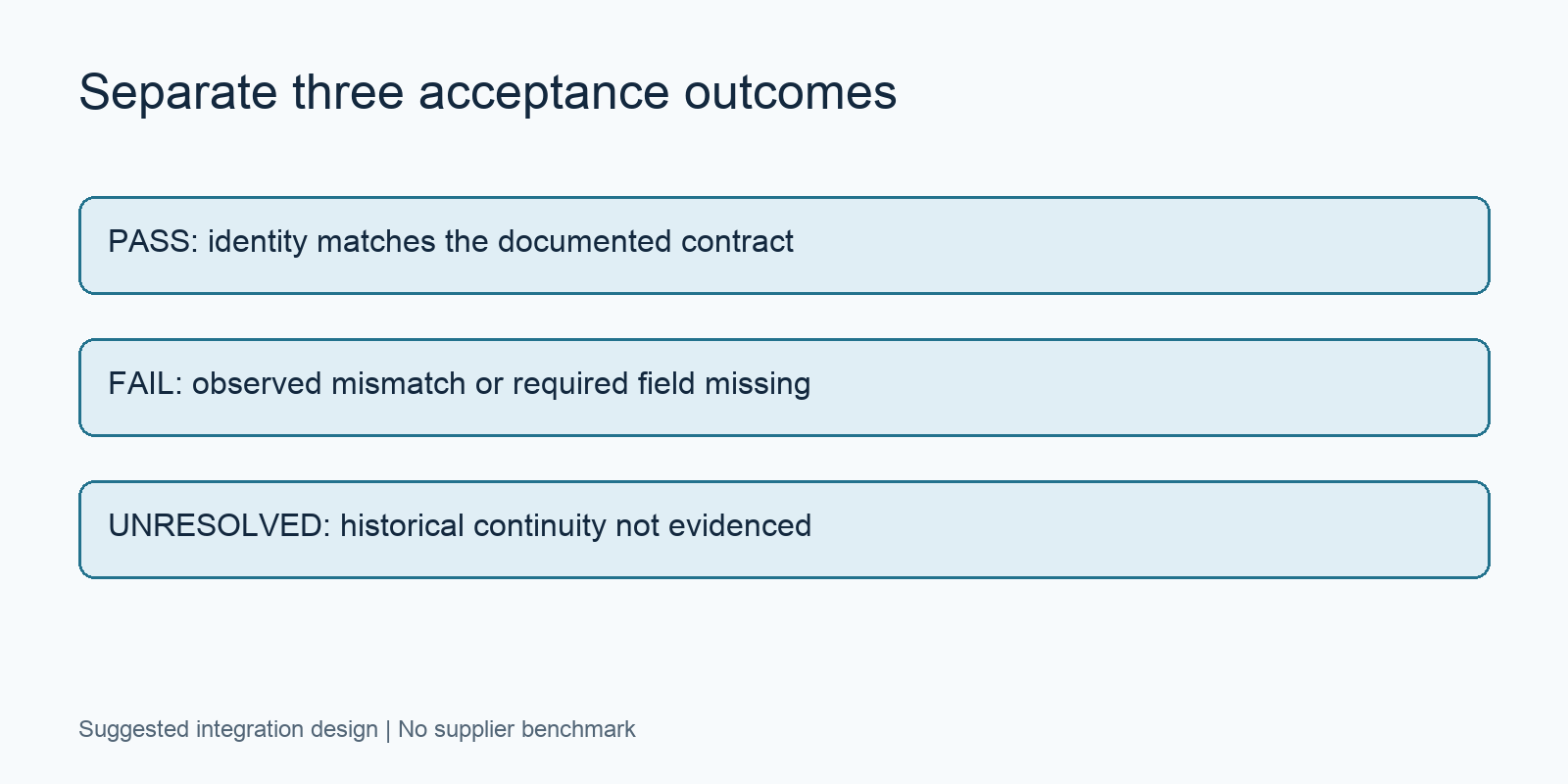
For a current-price widget, explicit symbol resolution and missing-field handling may be sufficient. For a historical portfolio simulation, make dated mappings and universe coverage contractual acceptance items. Ask for a documented example spanning a real change and retain the evidence. If that evidence is unavailable, mark the requirement unresolved; do not award a passing score simply because today's quote works.
The same boundary applies when evaluating TickDB: its documented stock-information fields support a current metadata inspection, while historical identity behavior must be verified independently for the intended use. This avoids turning a narrow endpoint description into a broad product promise.
Compare operational cost only after the identity gate
Once the basket resolves correctly, compare the cost of maintaining that mapping. Can the application refresh metadata within documented limits? Are unsupported instruments distinguishable from temporarily missing data? Can the team explain and reproduce a mapping change? Record these outcomes separately from response latency.
A useful comparison sheet contains three states for every requirement: evidenced pass, observed failure, and unresolved. An unresolved mandatory identity requirement should block acceptance for the affected workflow. Optional display metadata can remain a documented limitation if the interface handles it honestly.
This method does not rank providers universally. It tells you which candidate can satisfy your application's identity contract with evidence you can maintain. A fast quote becomes useful only after the application knows what it is a quote for.
Source reviewed: TickDB Docs, Stock Information, November 12, 2026. Code examples use synthetic data and are not supplier benchmarks.