How to Choose a Forex Data API: Why a Rate That Works for Conversion May Not Be Enough for Monitoring
TickDB Research ·
How to Choose a Forex Data API: Why a Rate That Works for Conversion May Not Be Enough for Monitoring
Abstract: For product managers and technical leads selecting a forex data API for a financial application, this guide compares ECB reference rates, Frankfurter and TickDB across reference conversion, intraday displays and bid–ask spreads. Real EUR/USD queries clarify reference dates, quote timestamps and price fields, then show when a free reference-rate path is sufficient and what to test before adding a market-data service.
A multi-currency asset page initially needs to translate euro amounts into dollars. Later, the product team wants intraday changes, observation alerts and a bid–ask spread.
Only a few numbers have been added to the screen. The data requirement has changed substantially. Can the original “latest exchange rate API” support all those features?
Keep a suitable reference source for reference-date conversion. For intraday alerts, verify quote time and updating; for a spread display, obtain both quote sides. The feature determines the input before the team compares free and paid access.
Around 10:22 Beijing time on November 16, 2026, we queried an ECB reference-rate route and a EUR/USD market snapshot. The reference observation was dated November 13. The snapshot contained a latest price, bid, ask and quote timestamp. Both returned a rate, but they delivered different inputs.
1. Three features need different inputs
| Feature | User judgment | First data requirements |
|---|---|---|
| Reference conversion under an agreed date and basis | Approximately how much are amounts worth on a common scale? | Source, reference date, base and quote currency |
| Intraday observation | What has changed relative to the observation starting point? | Pair, price definition, quote time and update method |
| Bid–ask display | How far apart are the two sides of this quote? | Bid and ask from the same source, their direction and time |
A reference-conversion feature may not need a live feed. Refreshing a daily reference endpoint more frequently does not turn it into intraday market data.
Reference rates can be candidates when the product explicitly uses a specified reference basis. Monitoring current activity requires checking quote timestamps and update conditions instead.
2. Keep a useful free path on the shortlist
The European Central Bank usually publishes euro reference rates around 16:00 CET on working days. They are quoted against the euro. The ECB describes them as informational and discourages their use for transactions.
An explicit source and date can be useful for appropriate reference displays and research. The product should explain that basis rather than present the result as an executable conversion price. Formal accounting requirements need their own assessment.
Frankfurter offers a convenient exchange-rate API. Its current v2 default blends multiple official sources; not every query simply forwards ECB data. If a feature requires a fixed benchmark, select a provider explicitly rather than silently using a blended result.
For this check, we selected Frankfurter’s ECB provider and queried EUR/USD:
| Field | Actual result |
|---|---|
| Reference date | November 13, 2026 |
| Base / quote | EUR / USD |
| Rate | USD 1.1052 per EUR |
| Query time | November 16, 2026, around 10:22 Beijing time |
At that reference rate, a hypothetical EUR 10,000 converts to USD 11,052. The amount is illustrative; the rate is from the actual response. This is a reference-date calculation, not a transaction quote for November 16.
The query took place on Monday morning before the usual daily publication time. A November 13 reference date has that timing context; its difference from a November 16 quote is not itself a provider error.
“Latest” means the latest published observation for that source. Check the publication schedule and returned date before deciding that an older date is unsuitable or that the endpoint failed to update.
If the feature needs that reference conversion, testing this free route first is sensible. A paid live feed does not become necessary merely because the application is professional.
3. Monitoring and spreads require more than one price field
The TickDB EUR/USD snapshot carried a quote timestamp of November 16, 2026, 10:21:59 Beijing time (02:21:59 UTC).
| Field | Actual value (USD per EUR) | Meaning |
|---|---|---|
bid_price | 1.10199 | The quoting side buys EUR |
last_price | 1.10203 | Latest price; not a substitute for bid or ask |
ask_price | 1.10206 | The quoting side sells EUR |
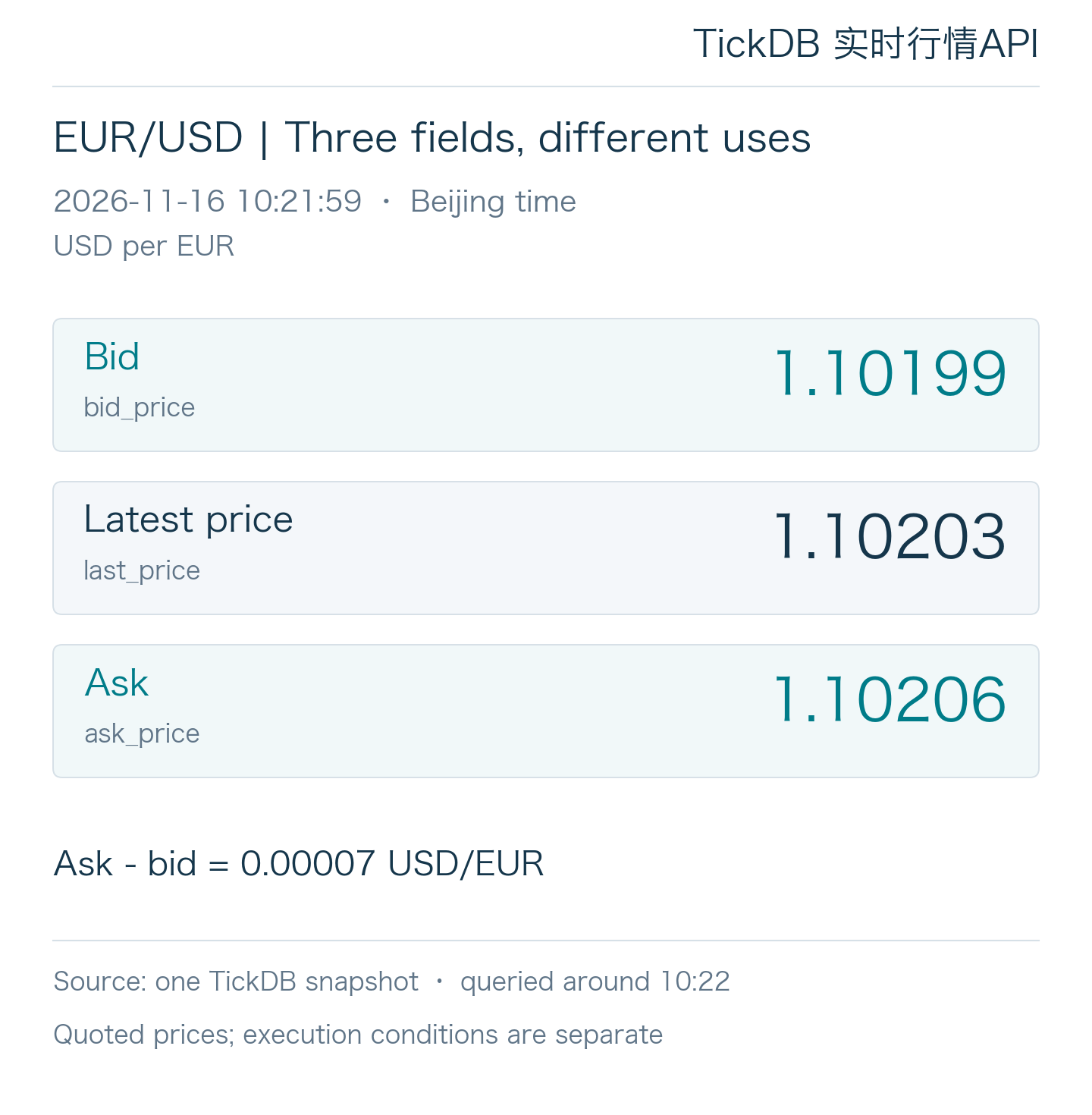
One snapshot, queried around 10:22. Quoted bid and ask are not a promise of execution.
Read the two sides from the quoting side’s perspective: bid is the quote to buy euros; ask is the quote to sell euros. A user buying euros therefore looks at the ask side and a user selling euros at the bid side. The latest-price field should not automatically be substituted for either side or for a midpoint.
The observed difference is 1.10206 − 1.10199 = USD 0.00007 per EUR. For a hypothetical EUR 10,000, the two quoted sides differ by USD 0.70. This explains the display’s meaning; it does not establish a customer’s complete conversion cost, which also depends on the transaction channel, fees and execution conditions.
This changes selection. A trend display needs a suitable price and time. A spread feature needs actual two-sided quotes for the target pair. A fresh latest price cannot replace missing bid and ask fields.
TickDB documents those fields as conditional on availability. One successful pair does not establish that every pair, session and account will return them, so the trial must cover the product’s own targets.
4. Put candidates in task order
For daily reference conversion, keep an ECB-based route or an explicitly selected Frankfurter provider first. Direct ECB downloads and Frankfurter’s ECB-provider route are two ways of obtaining the same benchmark, not two independent market quotes for cross-checking.
For a confirmed intraday feature, TickDB’s forex data API is a candidate to test. It supplies snapshot, historical bar and WebSocket paths for financial applications. This review obtained the EUR/USD latest price and both quote sides, providing a concrete starting point for a page-level trial. On the market page, inspect pair-specific price fields and timestamps, then the snapshot, historical-bar and subscription interfaces.
A snapshot is an on-demand result. A continuously updating page also requires checking the subscription path, access conditions and application design. This review did not test a live stream.
If the product’s core promise is an executable conversion price, start with the actual transaction channel and its execution terms. A market-data quote can be an observation input without being a price at which that user can trade.
| Requirement | First route | Work to defer |
|---|---|---|
| Daily reference conversion | ECB or an explicit Frankfurter provider | A live feed the feature does not need |
| Intraday observation | A relevant market-data service such as TickDB, tested for the target pair and time | Presenting frequently refreshed daily rates as intraday quotes |
| Spread display | A candidate returning actual bid and ask with clear direction | Deriving a spread from latest or an invented assumption |
| Executable conversion | The transaction channel and execution conditions | Treating an observation quote as guaranteed execution |
The order reflects different jobs, not a free-to-premium quality ladder.
5. A trial brief the team can decide from
| Item | Completed example |
|---|---|
| Feature | Keep reference conversion; add EUR/USD intraday observations and a quoted-spread display |
| Reference basis | Preserve the chosen provider and reference date |
| Market input | Check latest, bid, ask, their definitions and the displayed quote time |
| Evidence obtained | ECB-provider response dated November 13; November 16 snapshot with latest and two-sided quotes |
| Next trial | Check target pairs, field availability and updating during actual operating periods |
| Keep a route if | Fields exist, their direction and time are interpretable, and actual updating meets the product requirement |
| Missing-input display | Show source and date for reference values, quote time for market values, and “spread unavailable” when bid or ask is missing; do not substitute latest or zero |
The selection question is specific: which new judgment does this input support? Keep reference rates when conversion is the job. Verify relevant-time quotes for monitoring. Obtain explicit two-sided prices for spreads. That makes both integration work and spending easier to evaluate.
Sources and sample notes
- ECB Euro foreign exchange reference rates, checked November 16, 2026.
- Frankfurter v2 documentation on provider selection, blended defaults and reference-rate scope, checked November 16, 2026.
- TickDB forex product, snapshot and WebSocket Ticker documentation, checked November 16, 2026.
- Two requests completed around 10:22 Beijing time on November 16, 2026. Parameters and raw responses are retained internally. Notional amounts are illustrative; this article addresses data selection and product design, not forex trading advice.