How to Choose an A-Share Market Data API: Is One Successful Stock Query Enough for Market-Wide Screening?
TickDB Research ·
How to Choose an A-Share Market Data API: Is One Successful Stock Query Enough for Market-Wide Screening?
Abstract: For quantitative teams and tool owners extending end-of-day research into intraday stock screening, this guide compares specific AKShare, Tushare and TickDB interfaces. A real response containing 8,209 records illustrates how security scope, field units and update methods affect market-wide screening, historical research and candidate monitoring. It ends with a trial order and a completed decision card that research and engineering colleagues can use together.
Fetching Cambricon’s (688256.SH) latest price is a familiar A-share API demo. A screening tool needs more: examine the market, select candidates, investigate their history, then keep following them during the session.
“Supports A-shares” may describe single-stock history, a market-wide snapshot or an intraday interface requiring separate permission. A successful query for one stock leaves much of the selection decision unanswered.
On November 16, 2026, at 09:54 Beijing time, we retrieved 8,209 records from TickDB’s China-market bulk snapshot. Filtering by stock categories left 5,579 records. The rest included ETFs, indices, bonds and 43 records without a category.
Match the returned universe to the research universe before applying stock-selection rules. To make the comparison concrete, consider a small team that already uses Tushare daily history and now wants intraday observations.
1. Compare the screening task before comparing providers
Suppose the team performs price-and-volume research after the close, then follows selected candidates the next day. Its inputs span three connected stages.
| Stage | Decision | Input required |
|---|---|---|
| Market-wide screening | Which stocks meet the current observation criteria? | A defined security universe and the fields used by the screen |
| Historical candidate research | Does today’s activity still merit investigation in its historical context? | A specified range, interval and price basis |
| Intraday monitoring | Do candidates still meet the team’s conditions? | Relevant-time observations, an update method and appropriate access |
A current traded value condition can use a snapshot. A condition spanning several days requires history. After producing a candidate list, the tool may not need to retrieve the entire market repeatedly; that depends on how it makes subsequent decisions.
2. Why 8,209 records became 5,579 stock records
The bulk-snapshot request succeeded, with no duplicate symbols in the 8,209 records. Its category field produced the following breakdown.
| Group | category values | Records |
|---|---|---|
| Shanghai / Shenzhen / Beijing stocks | sh_stock, sz_stock, bj_stock | 5579 |
| ETFs | etf | 1686 |
| Indices | cn_index | 598 |
| Bonds | cn_bond | 303 |
| Unclassified | Missing category; retained for review | 43 |
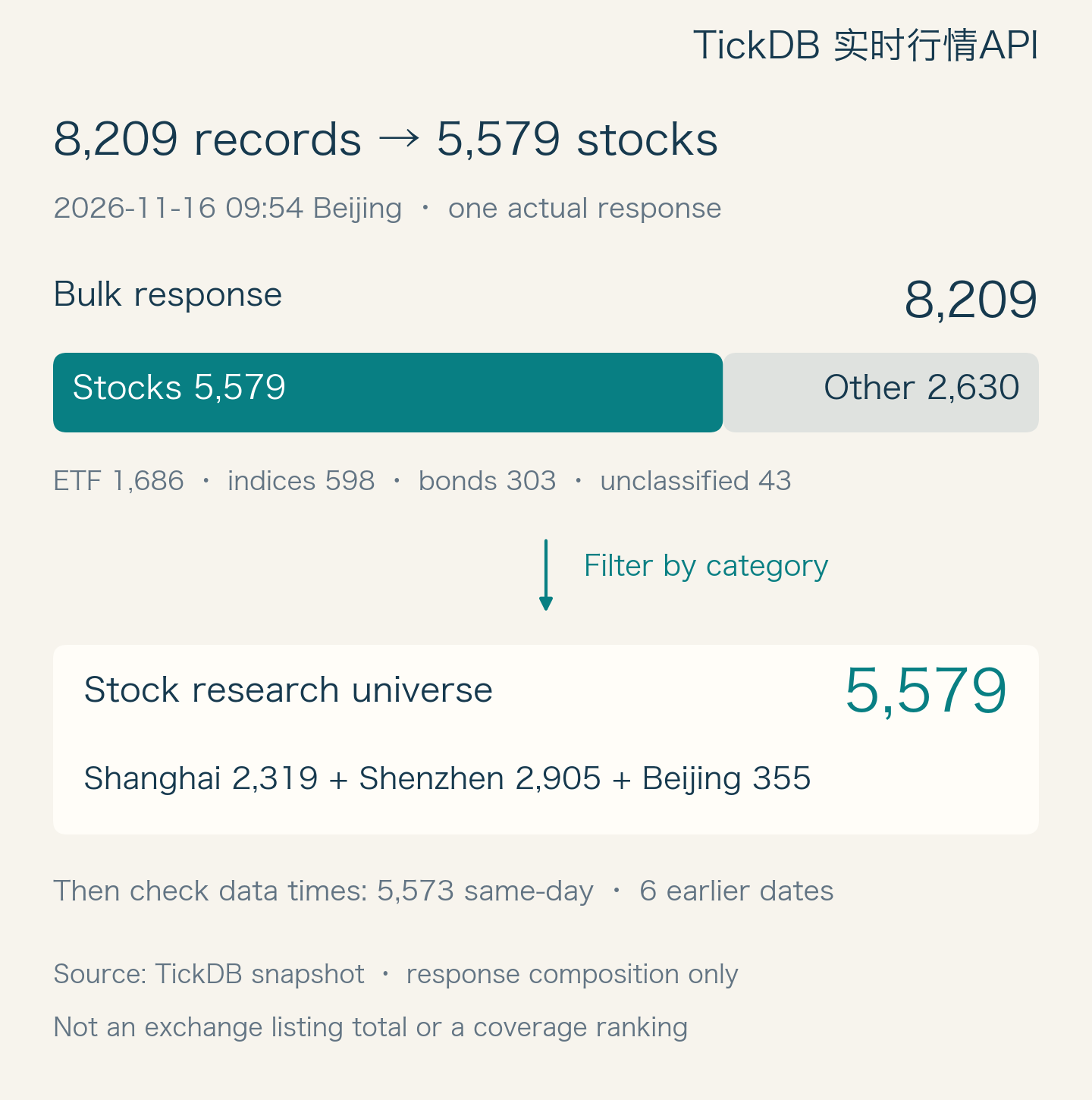
The stock categories contain 2,319 Shanghai, 2,905 Shenzhen and 355 Beijing records. These counts describe the available response captured at that time.
If the tool screens individual stocks, build its initial universe from the Shanghai, Shenzhen and Beijing stock categories. ETFs and indices may support other research, but should not silently enter the same individual-stock rules. Leave the 43 uncategorized records pending review rather than classifying them from their names.
Timestamps added another useful check. Of the 5,579 stock records, 5,573 carried a data date matching the capture date and six carried earlier dates. Preserve those times and investigate the earlier records with the relevant security status instead of treating every displayed price as an observation from the same day.
The procurement requirement should specify securities and observation times. A label such as “full-market support” does not establish that those requirements are met.
3. All three candidates have relevant interfaces
AKShare: start with its market-wide quote function
AKShare documents stock_zh_a_spot_em as returning real-time quotes for Shanghai, Shenzhen and Beijing A-shares in one call, including latest price, volume and traded value. It is not restricted to single-stock historical downloads.
For a Python prototype, this is a reasonable candidate. Test the actual universe and fields against the screen, then investigate the relevant historical interfaces, upstream conditions and continuing operation as needed.
Tushare: check intraday access before replacing an existing workflow
Tushare’s daily supplies unadjusted historical daily data after the trading session. Existing end-of-day research can continue using it. Intraday work calls for examining rt_k, rather than expecting the historical interface to update during the session.
Current rt_k documentation supports symbol wildcards and market-wide real-time daily observations, with separate permission. For a team already using Tushare, this should be an early check.
The interface returns requested observations. Refresh timing, repeat requests and exception display remain application decisions; a query response is not the same delivery mechanism as a persistent subscription.
TickDB: test the whole-market-to-candidate path
TickDB’s A-share data API provides bulk snapshots, individual-stock historical bars and streaming interfaces. A screening tool can test the bulk snapshot for its initial universe, retrieve candidate history, then assess subsequent updates. On the market page, first check bulk access and categories, then the candidate-history and update interfaces.
We also requested unadjusted daily history for Cambricon, 688256.SH, covering November 9–13. The actual response contained five bars, one for each date. This verified a small historical input step beyond fetching a current quote.
The application owns screening rules and candidate lists; the data service supplies inputs. Current bulk-snapshot documentation requires China full-market or enterprise access. Fixed historical start and end dates also require the appropriate K-line access conditions.
| Candidate | Starting point for the screen | First unresolved question |
|---|---|---|
| AKShare | stock_zh_a_spot_em | Do fields, actual scope and continuing-use conditions fit? |
| Tushare | Keep daily research; inspect rt_k | Do intraday permission and the request/update arrangement fit? |
| TickDB | Bulk snapshot followed by candidate history and monitoring interfaces | Do categories, historical range, permission and update method fit? |
AKShare and Tushare were checked against official documentation in this review. TickDB also has the two actual responses described above. This is not a three-provider performance benchmark.
4. Align traded value units before changing the interface
Familiar field names can hide differences that directly change a screen.
Tushare documents traded value in thousands of yuan for daily, but in yuan for rt_k. Volume is in lots for daily and shares for rt_k. AKShare’s quote function documents traded value in yuan and volume in lots.
For a unit-conversion example, CNY 100 million corresponds to 100000 in a thousands-of-yuan field, or 100000000 in a yuan field. The input numbers differ by a factor of 1,000 while representing the same amount.
This is not a proposed screening threshold. It shows why moving from end-of-day to intraday data requires aligning rule inputs, not merely changing refresh timing.
After aligning currency units, check the observation window. Yesterday’s full-session traded value and today’s value as of 09:54 cover different lengths of time. Compare equivalent progress when that is the research question. If the rule deliberately asks whether today has already exceeded yesterday’s total, retain that baseline and name it explicitly. The intended judgment determines whether to keep the rule, change the window or wait for the close.
For this TickDB bulk endpoint, volume_24h and quote_volume_24h are documented as current-day cumulative volume and traded value, not rolling 24-hour measures. That page does not explicitly state their quantity and currency units. This review did not run numerical threshold screens on those fields; verify the units before doing so rather than inferring them from magnitudes.
Historical prices also need an explicit adjustment basis. A current bulk snapshot cannot replace historical backtest inputs. Multi-day conditions require data for the specified range, interval and price basis.
5. Which candidates should this team try first?
For the team described at the start, check Tushare’s additional intraday interface first and use TickDB as a second combined-path candidate.
The first check asks whether existing infrastructure can support the new task. The second evaluates market scope, candidate history and subsequent updates through another route. The snapshot and five Cambricon bars are already available; the next useful trial is candidate updating under the tool’s actual refresh requirements.
Defer a third integration with AKShare for now because this team already has a working research workflow and no established need for another route. For an individual starting a new Python prototype without an existing database, the order can change: AKShare’s market-wide function is a direct place to start.
| Decision item | Completed example |
|---|---|
| Task | Add market-wide screening and intraday candidate observations to existing end-of-day research |
| First candidates | Check Tushare real-time daily access; test TickDB’s bulk/history/monitoring combination |
| Observed result | 8,209 TickDB records, including 5,579 stock-category records; five Cambricon daily bars for the specified range |
| Align first | Security universe, data time, traded value/volume units and historical price basis |
| Next trial | Reconcile the target list: returned and missing symbols, request completion time, data times and missing fields |
| If something is missing | Keep earlier-date or absent records pending review; do not label unknown inputs as failing a screen. Assess them against the application’s update requirements |
| Defer | A third integration and a full historical-library migration |
Require each candidate to satisfy a concrete stage of the research task, then compare fees and integration effort. One successful quote is a beginning; the selection decision concerns the tool’s complete judgment process.
Sources and sample notes
- AKShare stock-quote documentation, including
stock_zh_a_spot_em, checked November 16, 2026. - Tushare
dailyandrt_kdocumentation, checked November 16, 2026. - TickDB bulk snapshot, K-line and WebSocket Ticker documentation, checked November 16, 2026.
- TickDB responses captured at 09:54 Beijing time on November 16, 2026; parameters and raw results are retained internally. Counts describe this response, not exchange-wide listing totals. Examples concern data selection, not investment recommendations.