Choosing a Gold Price API: Is International Gold Enough for a Gold ETF Tool?
TickDB Research ·
Choosing a Gold Price API: Is International Gold Enough for a Gold ETF Tool?
Abstract: A gold ETF page needs more than an international gold quote. Using actual 518880.SH and XAUUSD responses alongside exchange and fund-manager information, this article separates ETF trade prices, international gold references and fund NAV, and provides a product-input checklist plus a reproducible holding-value calculation.
“Show gold, show my holding value, show today's change” sounds like one small product requirement. It is several data requirements. An international gold quote can keep changing at night while a domestic ETF record remains timestamped in the afternoon. The fund manager's NAV is another input again.
One page-wide “updated now” label can make those different numbers appear synchronized.
Start with the actual fund
The Shanghai Gold Exchange lists fund 518880, Huaan Yifu Gold ETF, against the closing price of its Au99.99 contract. Huaan's product page identifies code 518880 and currency CNY, and separately publishes unit NAV.
A holding-value feature needs the ETF's own per-share price. International gold is relevant market context, but it is not a substitute for that fund-share price. The World Gold Council likewise distinguishes spot, LBMA benchmark and regional prices.
Two records from one request had different times
On November 16, 2026, one TickDB snapshot request for 518880.SH,XAUUSD returned:
| Object | Raw latest-price field | Data time, UTC+8 |
|---|---|---|
| 518880.SH, Huaan gold ETF | 7.852 | November 16, 15:00:01 |
| XAUUSD, gold/US dollar | 3873.51000 | November 16, 23:19:09 |
The timestamps were 8 hours, 19 minutes and 8 seconds apart. They are unsuitable for an unqualified same-instant performance comparison. They do show why each number needs its own time label.
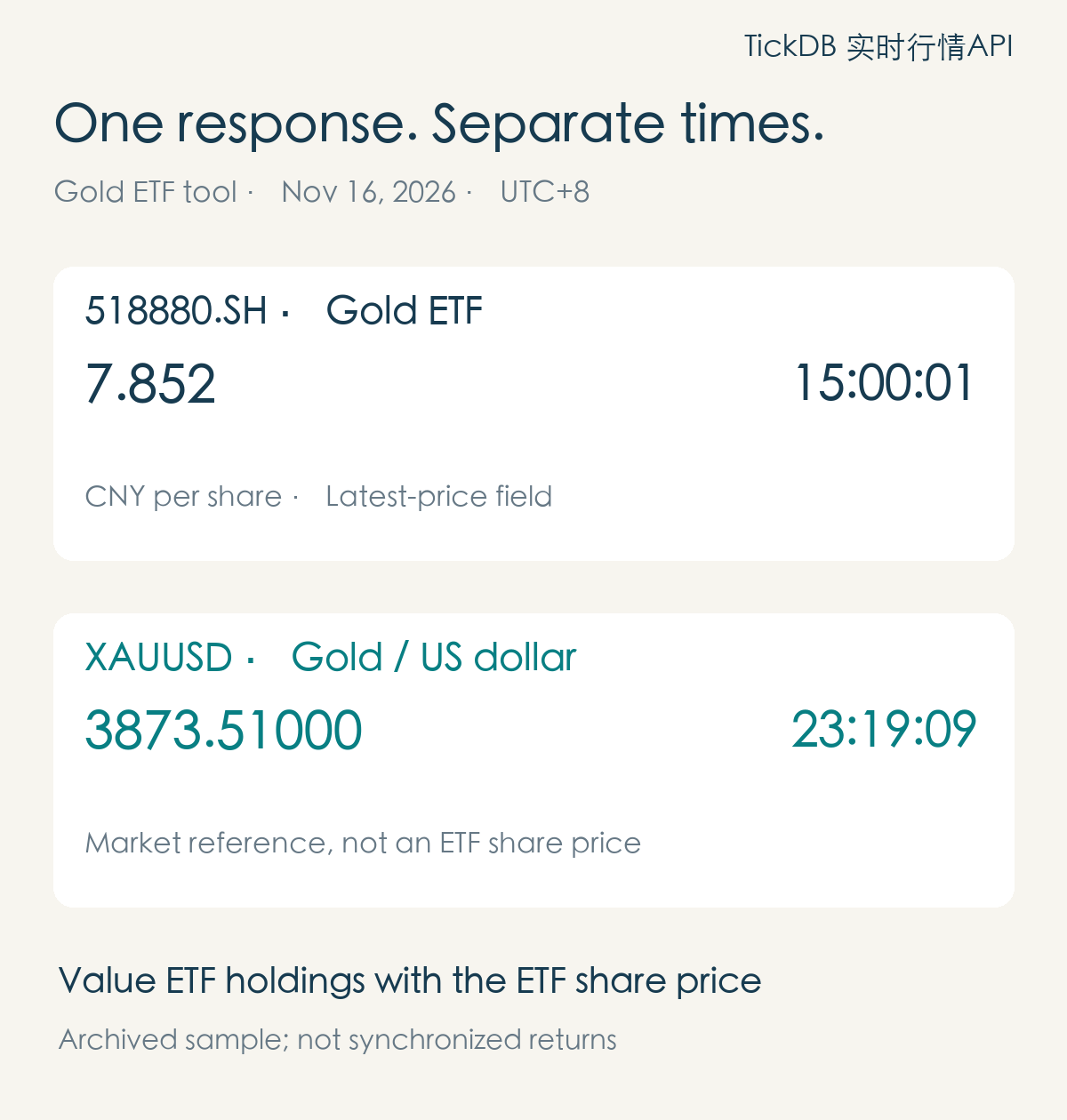
This figure presents two archived quote objects, not synchronized returns. Their scales and timestamps differ.
Keep request receipt time in operational records. On the product page, show the ETF timestamp beside the ETF price and the international quote timestamp beside its own number. Determine market status using the relevant calendar and sessions; timestamp separation alone does not diagnose an API fault.
Which price values 1,000 ETF shares?
For a teaching holding of 1,000 shares, the archived ETF price gives:
1,000 shares × CNY7.852 per share = CNY7,852.00
This is a reference market value at that quote's timestamp, before fees, not a guaranteed liquidation amount. Holding profit or loss additionally requires cost basis and the applicable fee treatment.
Multiplying XAUUSD by 1,000 ETF shares mixes different units. Currency conversion alone does not turn a fund share into a fixed quantity of gold.
from decimal import Decimal
etf_price = Decimal("7.852")  # Archived 518880.SH quote
teaching_shares = Decimal("1000")
print(f"CNY {etf_price * teaching_shares:.2f}")
CNY 7852.00
NAV is another product requirement
During the same evening's check, Huaan's official page displayed November 16 unit NAV of 7.8814, whereas the archived latest trade-price field was 7.852. These are different data objects, rather than an automatic indication that one source is wrong.
An intraday premium/discount feature needs an appropriate reference input and calculation convention, including a verified IOPV source where relevant. A NAV published in the evening must not be treated as information already available at every earlier intraday moment.
| User task | Required inputs | Can an international gold quote do it alone? |
|---|---|---|
| View this ETF's price | ETF identity, per-share quote and timestamp | No |
| Value a fixed share holding | Shares, ETF quote and currency | No |
| Observe international gold | Defined price object, units and timestamp | As corresponding market context |
| Calculate holding P&L | Quote, shares, cost and fees | No |
| Show NAV or an intraday premium/discount | Suitable NAV/IOPV, time and method | No |
TickDB's specific role in this example was to supply A-share ETF and gold/US-dollar quote inputs through one REST snapshot endpoint while retaining separate identities and timestamps. That can simplify querying; it does not establish NAV, IOPV or a complete fund-valuation service.
Because the main task is a domestic ETF page, the TickDB A-share market data page is the relevant next step. List fund valuation, fees and subscription/redemption information separately when the product needs them.
Before comparing gold API suppliers, write one sentence for each number on the page: what decision should this number help the reader make? The answer determines the input to buy.
Sources: Shanghai Gold Exchange gold ETF list; Huaan 518880 product page; World Gold Council “Gold spot prices”; TickDB snapshot documentation and November 16, 2026 raw response. All holding quantities are teaching assumptions.