Choosing a Hong Kong Stock Quote API: What Changes When a Script Moves to a Server?
TickDB Research ·
Choosing a Hong Kong Stock Quote API: What Changes When a Script Moves to a Server?
Abstract: Moving a personal Hong Kong stock script to a team server requires more than comparing API prices. Using Futu OpenD's official operating conditions and one actual Tencent quote response, this article separates gateway maintenance, login, quote entitlements, data timestamps and intended use into a practical trial checklist.
A personal quote script works. The next task is a team dashboard running on a server. Who checks login state after a restart? Who notices a permission change? What time does the displayed price actually represent?
One tempting shortcut is to classify broker APIs as desktop-only and independent APIs as cloud-ready. Futu's own documentation contradicts that shortcut: OpenD can run locally or on a cloud server, including through a command-line version.
Compare the conditions your team must maintain, rather than assuming the category determines the deployment outcome.
Compare the same job
The example job is an internal Hong Kong stock observation dashboard, without order execution.
| Condition | Futu OpenD path | Direct REST path |
|---|---|---|
| Components | Application, OpenD gateway and connection | Application and HTTP requests |
| Access | Login and applicable entitlements | API key and applicable entitlements |
| Server operation | Officially supported locally and in the cloud | Test connectivity on the intended server |
| Data conditions | API rights, rate limits and quotas | Symbols, fields, limits and account conditions |
| Intended use | Confirm the actual team or product use | Confirm the actual team or product use |
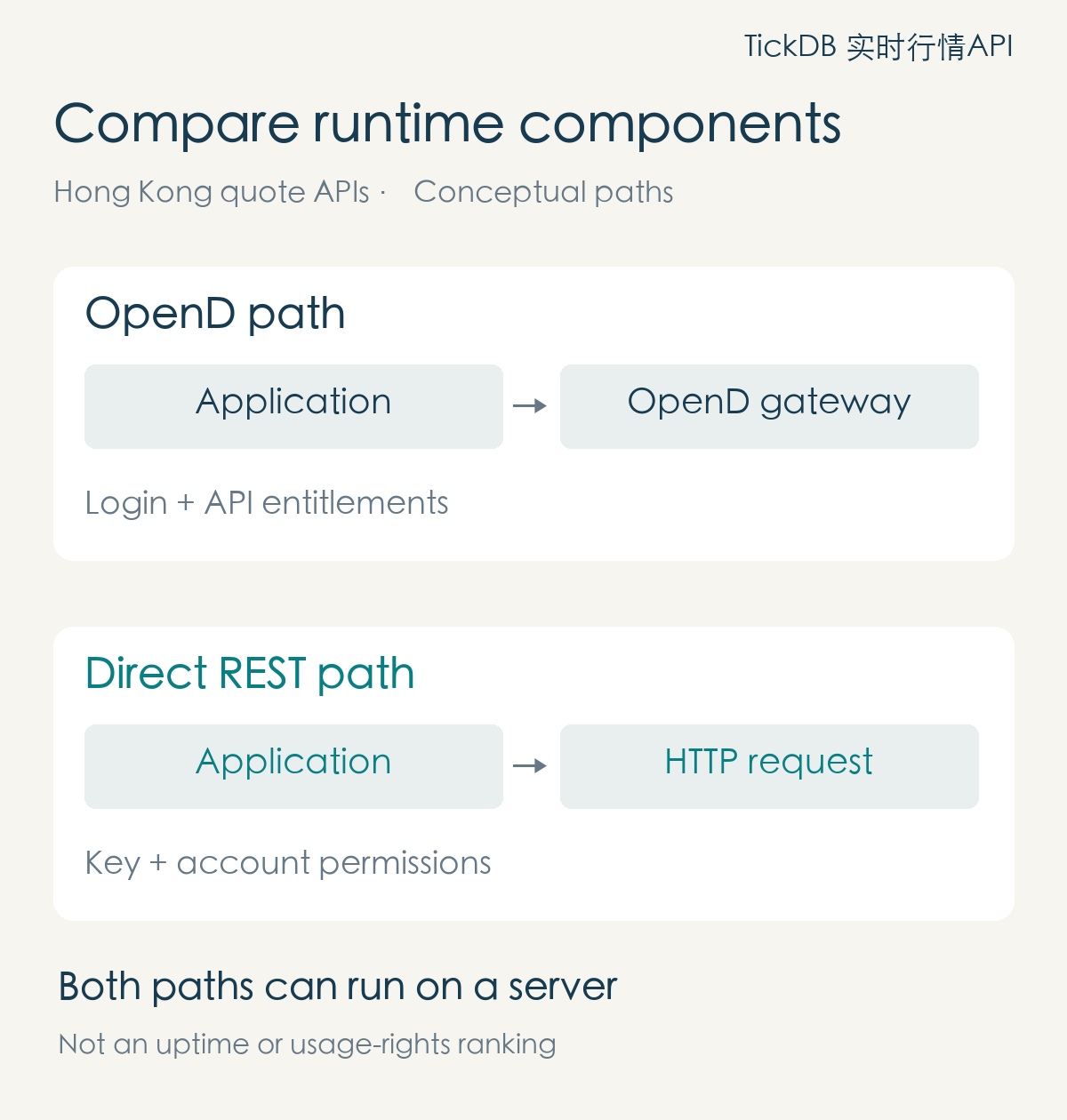
This is a component diagram, not a reliability ranking. Both paths may run on a server. Fewer self-managed components do not establish better uptime or broader usage rights.
APP access is not an API entitlement check
Futu documents support for Windows, macOS, CentOS and Ubuntu. After login, OpenD starts a Socket service. Its API quote permissions are not identical to APP permissions; rate limits, subscription quotas and historical-bar quotas are separate conditions.
Check those conditions for the actual account before assuming that a price visible in the APP is also available to a server program. Apply the same discipline to a direct API: authentication success alone does not validate every field or intended use.
What the actual quote returned
On the evening of November 16, 2026, a TickDB REST snapshot request for Tencent, 700.HK, returned HTTP 200 and business code 0:
symbol: 700.HK
name: 腾讯控股
last_price: 390.4
data timestamp: 2026-11-16T16:08:13+08:00
The request was made in the evening, but the returned record was timestamped 16:08:13. A page must not turn request receipt time into a claim that a trade just occurred. We did not establish the precise market phase of this record or call it an official closing price.
This was a minimal request test, not a production cloud deployment. Server connectivity, secure key loading, restart recovery and continued updates remain deployment checks.
The TickDB Hong Kong market data page introduces the direct access option used here. For this request, the application made an API-key-authenticated HTTP call without starting a broker gateway. Confirm the permitted team or customer-facing use separately.
A small server-side trial
Use Python 3.9 or later, install requests (pip install requests), and provide your own key through a secure environment configuration. The code requests one snapshot; outputs change with the actual response.
import os, requests
from datetime import datetime
from zoneinfo import ZoneInfo

r = requests.get("https://api.tickdb.ai/v1/market/ticker",
    params={"symbols": "700.HK", "type": "stock"},
    headers={"X-API-Key": os.environ["TICKDB_API_KEY"]}, timeout=20)
r.raise_for_status()
result = r.json()
if result["code"] != 0:
    raise RuntimeError(result.get("message", "Quote request failed"))
rows = [x for x in result["data"] if x.get("symbol") == "700.HK"]
if len(rows) != 1:
    raise RuntimeError("Expected exactly one 700.HK record")
x = rows[0]
stamp = datetime.fromtimestamp(x["timestamp"] / 1000,
                               ZoneInfo("Asia/Hong_Kong"))
print(x["symbol"], x["last_price"], stamp.isoformat())
Parsing the archived response produced:
700.HK 390.4 2026-11-16T16:08:13+08:00
Keep the existing path when it fits
If OpenD already works for the team, its maintenance is manageable and the account conditions match the job, keeping it is a reasonable option. If an observation dashboard needs a simpler component setup, trial direct HTTP access against the same requirements.
First verify one security's identity, fields and timestamp. Then expand to the actual watchlist and check missing records. Run on the intended server, retain real errors and test restart behavior. Define how a stale or missing value appears on the dashboard. Finally, confirm symbol scale, frequency and intended use with the provider.
A page that needs continuous changes also needs a separate streaming and recovery test. A successful REST snapshot is only the snapshot part of acceptance.
The useful decision is whether the present shortfall is data, permissions or maintenance effort. Address that shortfall before replacing a working system.
Sources: Futu API “OpenD Overview” and “Authority and Quota”; TickDB snapshot documentation and the November 16, 2026 archived response. Futu operating performance was not tested.